


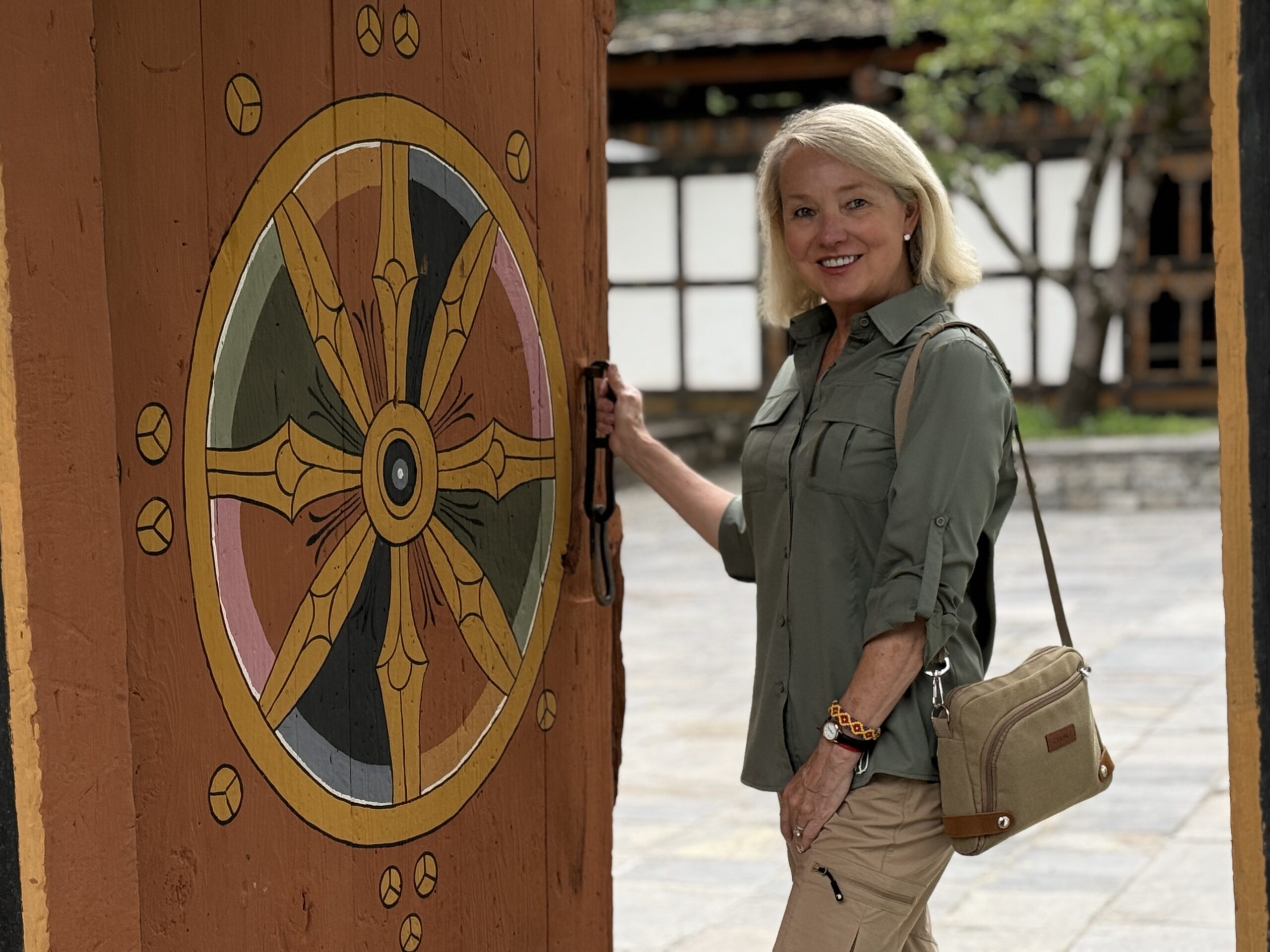
How Bhutan marks a year, and what I would have asked for, had I known to ask.
On the twenty-first of September we walked into a room in the fortress at Trongsa where eighty monks were chanting. Nobody had arranged it. Our guide put his head through the door, saw what was happening, and let us stand at the edge of it.
The sound filled the hall the way water fills a container: completely, and without any apparent effort. We stayed perhaps ten minutes and left without anyone acknowledging us, which was correct.
It was a longevity ceremony. I didn’t know that at the time.
Two days later, in a small temple in Bumthang, two monks gave my husband and me Buddhist names. We lit butter lamps and made a wish, then sat cross-legged on a carpet while they chanted, accompanied by a bell, a drum and a pair of cymbals. At the end they wrote the names out on paper in Dzongkha script. Mine is Kelzang Choden: good fortune, endowed with the Dharma. My husband’s is Tshering Dorji.
Tshering means long life. Dorji is the thunderbolt, the diamond, the thing that cuts everything and is cut by nothing. Indestructible long life.
The following evening, all three flights out of Bumthang were cancelled and we were stranded a night nobody had booked. The pillow gift still came. It was a dorji key hanger, and the card explained that the locket is made with a blessed thread to protect from accidents, misfortune and harm in general. We read it the night before choosing between a fourth cancelled flight and ten hours of mountain road.
We took the road. It took nine hours and we passed several landslides.
We arrived in Paro on the twenty-fifth of September, which was my milestone birthday. The lodge manager and several of his staff were waiting at the car with birthday wishes. That night a cake came to the table with small personalized flags carrying the eight auspicious symbols, and someone tied a white scarf bearing the same symbols around my neck.
Four blessings for long life in five days. I had asked for exactly one of them.
Bhutan Doesn’t Really Have Birthdays
Here is the thing I didn’t know until I asked: Bhutan doesn’t really have birthdays.
Traditionally, age wasn’t counted from a personal birth date at all. Everyone advanced a year together at Losar, the new year: one shared reckoning for an entire country. Individual birth dates weren’t recorded and weren’t marked, and many older Bhutanese don’t know theirs.
This is why the Fourth King’s birthday in November became National Day rather than a private occasion. Cakes and candles arrived with modernization, and among younger urban Bhutanese they’re now ordinary.
So the cake at my table was an import. A gracious one, and thoughtfully done, but an import.
The Khadar Is Not an Import
What isn’t an import is the scarf.
It’s called a khadar, and it is the central object of Bhutanese social ritual. It’s offered at arrivals and departures, at weddings and promotions, laid before altars and images, presented to people being honored.
Placing one around someone’s neck is the everyday Bhutanese form of blessing and respect, the same gesture Bhutanese people make to one another. It isn’t decoration and it isn’t a lei.
Which meant the evening was a hybrid, and the more interesting for it. The lodge hadn’t replaced the familiar thing with a local one, and it hadn’t simply produced a cake either. It had taken a foreign custom and set a Bhutanese frame around it.
That is a harder and better piece of hospitality than either alternative, and I’ve thought about it more than I expected to.
The part I don’t put on the blog
Weekly Wanderlust readers get what I learned about asking for moments like these, and when to ask. It’s my Friday letter.
The Tshewang: Bhutan’s Long-Life Blessing
Bhutan does have a way of marking a significant year. It just isn’t a party.
It’s called a Tshewang: a long-life blessing. A ritual to extend the span the astrologers have foreseen. Six to eight monks, prayers and mantras, a cleansing ceremony, butter lamps, and at the close a dorji or a sacred scripture laid on the head.
In one valley it is held in a small fortress beside the great dzong, built six hundred years ago by a yogi and struck three times by flood, and each time the Buddha inside survived.
That is what I would have asked for, had I known to ask.
And it’s what I had walked into at Trongsa, four days before my birthday, without recognizing it.
What You Cannot Arrange
Good fortune endowed with the Dharma is not a souvenir. Neither is indestructible long life, handed to a man about to drive ten hours past landslides.
What you cannot arrange is the accumulation. Eighty monks in a hall you walked into by accident. A name you didn’t choose. A protective object handed over on a night that wasn’t supposed to exist. A white scarf after nine hours of landslides, on the day itself.
I asked for one blessing. Bhutan gave me four.
There is a way to ask for this, and it starts long before you land.
Start with the right question
I share what to ask for, and when to ask it, in Weekly Wanderlust, my Friday letter. It’s where I put what I learned on the ground in Bhutan.
Thinking about Bhutan for 2027? Start here.
Related: What Cannot Be Photographed: a journey through Bhutan
Julie traveled to Bhutan at full retail rates; the trip was not sponsored. As a travel advisor, she earned commission on her own booking through her host agency and may earn commission when clients book the lodges mentioned.


