


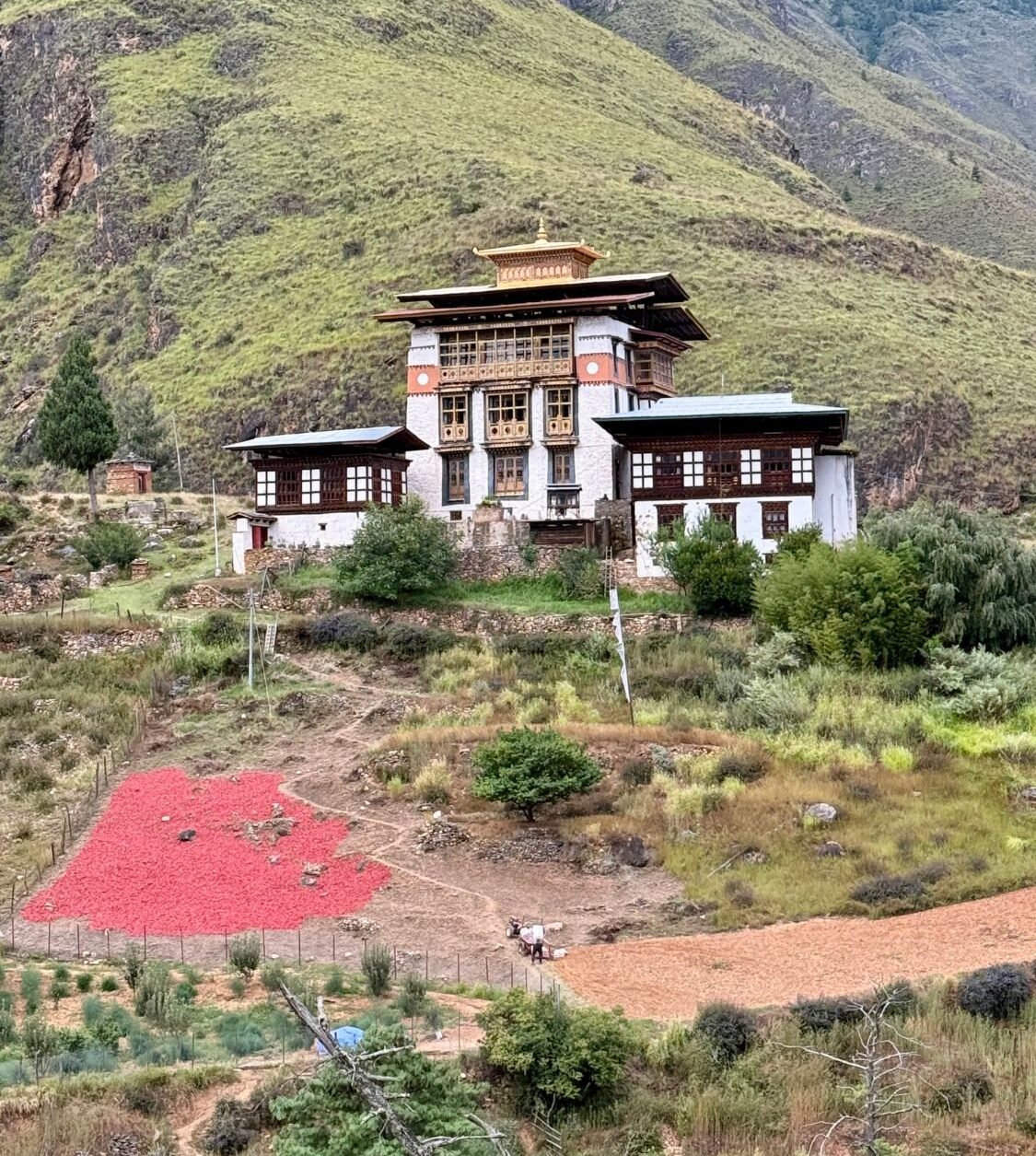
A journey through Bhutan, across five valleys and five Amankora lodges, told in the senses a camera cannot hold.
Cameras are not permitted inside Bhutanese temples. At some you surrender your phone at the door; at others it is enough to leave it in your bag, but the rule is the same and nobody bends it.
I understood this as a restriction for about three days. Then I began to understand it as an accurate description of the country.
The most impactful experiences in Bhutan cannot be photographed. Not because they are forbidden, though some are. Because they are not the kind of thing a photograph holds.
Sound
Begin with sound, since it arrives first.
Dzongkha attaches an honorific particle, la, to the end of almost every phrase, which means that ordinary speech arrives already softened. Kadrinchey la. Thank you. You hear it constantly, from the person handing you a key and the person taking your shoes, and after a week the absence of it in your own language starts to feel like a rudeness you had never noticed committing.
In a small temple in Bumthang, two monks performed a naming ceremony for my husband and me. We lit butter lamps and made a wish, then sat cross-legged on a carpet while they chanted, accompanied by a bell, a drum and a pair of cymbals. It lasted perhaps an hour. At the end they wrote our Buddhist names on paper: Kelzang Choden, Tshering Dorji.
Good fortune, endowed with the Dharma. Indestructible long life.
Days earlier, at the fortress at Trongsa, we walked into an assembly hall where roughly eighty monks were chanting a longevity ceremony. Nobody had arranged this for us. Nobody stopped. We stood at the edge of a room in which something was simply happening, as it had that morning and would the next.
And at night, rain. Monsoon rain on stone paths and metal roofs, the most ordinary sound in Bhutan and the one I still hear.
Sight
Sight, then, though this is where the camera’s failure gets embarrassing.
I have photographs of monks. I have none of the way their hands move while they chant, in unison, over and over, a slow articulate rotation that is not decoration but practice. These are mudra, ritual gesture, one of the three gates of Vajrayana Buddhism alongside speech and mind. They look, to a Western eye, like something being said in a language the hands know.
I have no photograph of a woman at a chorten spinning a hand-held prayer wheel while telling a rosary, stacking recitations, entirely unbothered by us. Or of the imprint in the rock at Kurjey Lhakhang where Guru Rinpoche is said to have meditated in the eighth century, and where Bhutanese pilgrims press forward to see something I could describe accurately and convey not at all.
And I have no photograph of the thing I will remember longest, which is what happens to a Bhutanese face when your eyes meet.
Smell
Smell is the shortest section and the hardest to write. Butter lamps. Clarified butter burning in brass, in rooms that have smelled this way for centuries, an offering of light against ignorance and an accumulation of merit that costs the giver something real.
At Kurjey the lamps are kept outside now, after a fire started by one indoors. The smell is the same. It simply arrives in the open air, which changes it, the way a thing moved outdoors is always slightly less itself.
Touch
Touch is where the camera gives up entirely. Sound has recordings. Weight has nothing.
Baby yak wool, hand spun and woven into a scarf, is softer than it has any right to be. The softness is the undercoat, the fine down beneath the coarse outer hair, and the animal grows it because of where it lives. The altitude and the softness are the same fact.
Tsa tsa are small votive stupas pressed from clay in a mold, made as an act of merit and left at shrines, in caves, beside trails. They are the size of a plum. They weigh more than they should. The clay is often mixed with blessed substances and sometimes with the ashes of the dead, and you can feel this before anybody tells you, which is the only reason the detail is worth reporting.
And a hot stone massage with blended oils, after a day of altitude, which requires no interpretation at all.
More from Bhutan, on Fridays
Some of what I learned in Bhutan doesn’t belong on a blog. I share it with readers of Weekly Wanderlust, my Friday letter.
Taste
Taste, with a caveat I would rather make than have a reader catch.
Our guide advised us not to eat anywhere but the lodges. This is standard advice and sensible advice, and it means that my exposure to Bhutanese food was bounded by the property line.
The farmhouse lunches and the cooking sessions are lodge productions. The gardens are organic and on-site, the honey and eggs are theirs, the cooking is excellent and it is prepared to Western standards. So: I ate Bhutan’s food the way most visitors will, which is to say at a remove.
This is worth saying plainly, because it is the one place where the country did not reach me directly. Everywhere else the filter was down. I stood inside working temples, at a village festival held for villagers, in a room where eighty monks were not performing. The food was the exception.
What I can speak to is butter tea. Suja. Milky, chalky, faintly savory, unlike anything I had a category for. Unrecognizable, and I mean the word precisely: I could not place it, and that failure was the most honest thing I tasted.
The Chilies, and the Photographs
Which brings me to the chilies, and to the photographs.
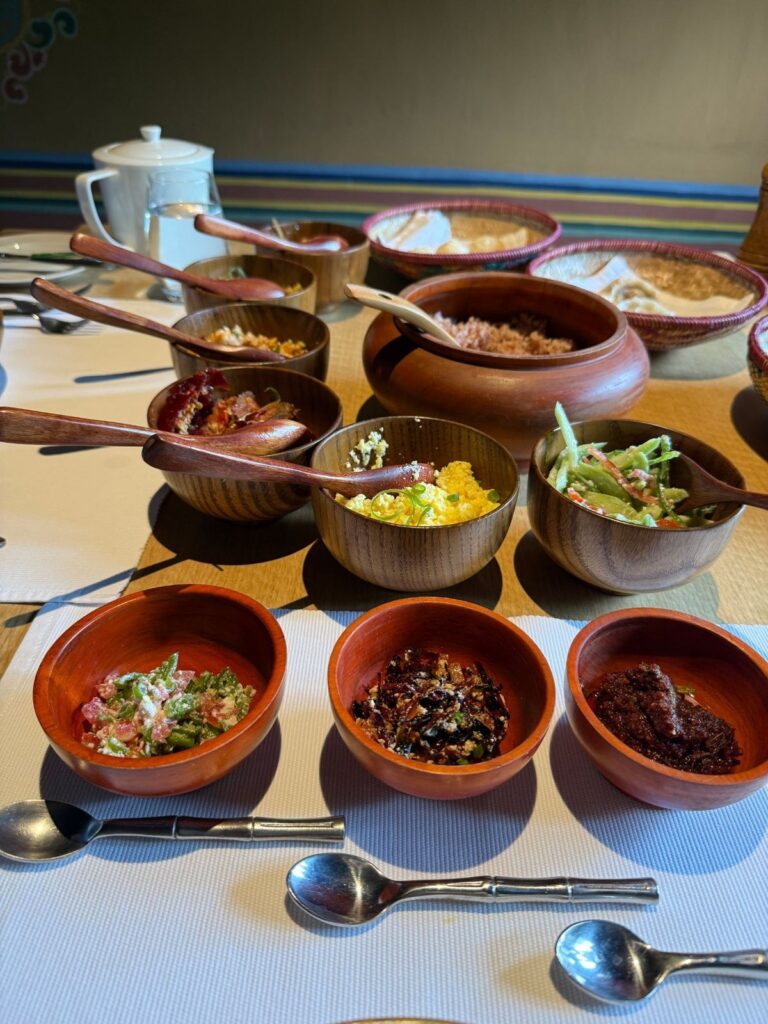
Chili is not a seasoning in Bhutan. It is a vegetable. Ema datshi (chili and cheese) is named without euphemism for exactly what it is, and it arrives at every table beside the potato version, the mushroom version, the pork sautéed until the peppers slump. Then the ezay, the paste, in case the dish has been insufficiently honest with you.
The rooftops are red with them. Whole valleys of drying peppers laid out on tin and shingle, and this is the one thing you can photograph. The one taste with a picture attached.
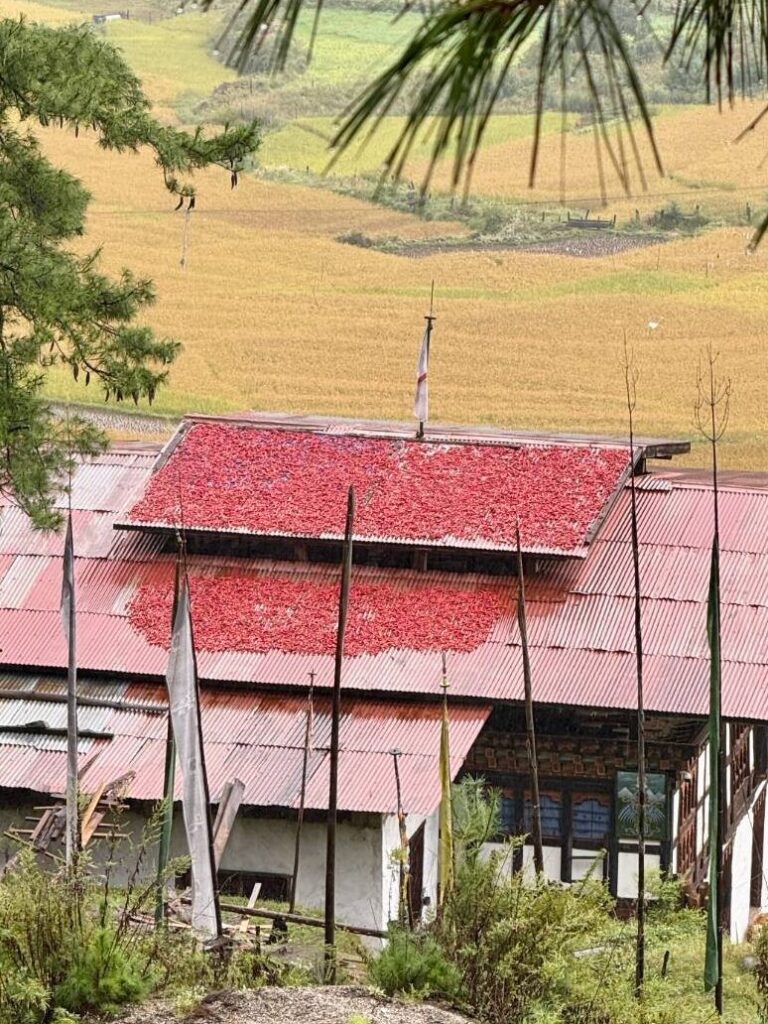
The picture is the least true part of it, and not only for the reason I expected.
In the library at the lodge in Bumthang I found Chilli and Cheese, Kunzang Choden’s account of her country’s food. She dates the chili’s arrival in Asia to four or five hundred years ago, and later still in the Himalaya.
It came from South America (tiny berries on vines beneath the Amazon canopy), carried east by the Spanish and Portuguese, refused by European palates, embraced across Africa and Asia, traded into the region as “Calcutta chilli,” and then moving north with merchants and pilgrims, over the passes, into the valleys.
Which is to say that the flavor defining Bhutan more completely than any other is younger than Pema Lingpa, the Bumthang saint whose lake and monastery I had spent the week visiting. It is younger than most of the temples I had stood in. The thing that tastes oldest arrived last.
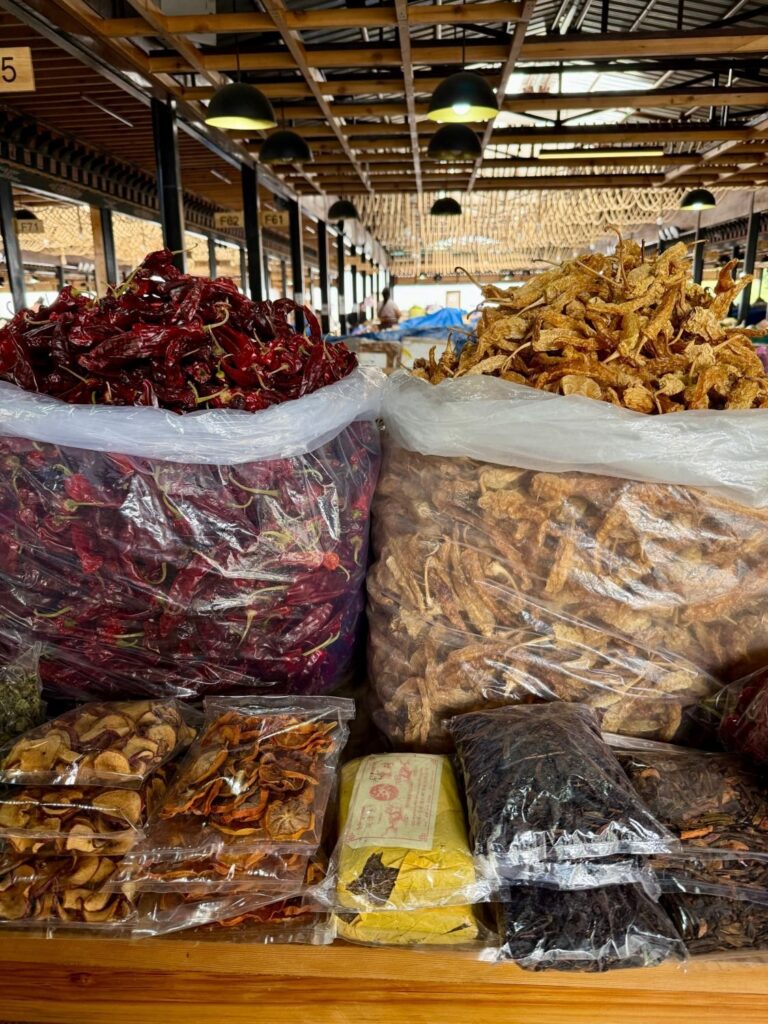
Choden also describes how it is handed on. Bhutanese children come off bland infant diets and are initiated into chili; parents boast that a child can already manage it, and promise that eating it will make them grow fast (not entirely folklore, since chili sharpens the appetite).
And older siblings and parents lift meat and vegetables from their own plates, suck the chili taste out of them, and pass them down to the smaller children. Eating chili is what being grown up tastes like. The children are proud when they can.
A whole country teaching itself to eat fire, one sibling at a time, for five hundred years.
What the photograph leaves out is all of that, and the flame. Not the flare of the first bite but the long occupation afterward: through the meal, through the drive, into the night, still making its case the following morning. I have the images. They are beautiful. They are also proof of nothing.
The camera took the color. My body kept the record.
Want the part I didn’t put on the blog?
Weekly Wanderlust is my Friday letter: what I learned on the ground in Bhutan and elsewhere, the questions worth asking before you book, and the stories that don’t fit in a caption.
Thinking about Bhutan for 2027? Start here.
Julie traveled to Bhutan at full retail rates; the trip was not sponsored. As a travel advisor, she earned commission on her own booking through her host agency and may earn commission when clients book the lodges mentioned.


